A model wrapped in the loop that rewrites it
Requests climb the spine: parse, read the conversation, route to one of 267 specialists or an organ, check, speak. Around everything runs the self-improvement loop, and no change reaches the served model without passing its gate. Drag to orbit; click a layer to open it.
Record, propose, examine, serve
Record
A wrong turn becomes a structured failure record in the inbox.
Propose
A small, named repair, a new organ or a new specialist. w536 let the relation specialists answer relation questions first; w538 fixed three defects found by sealed dialogue tests.
Examine
4,114 held-out checks. Lose one correct answer, or assert one wrong conclusion, and it is rejected. A release also faces a sealed test, written before the build and run once.
Serve
The tip moves in HEAD_MANIFEST; every service resolves the same verified head.
What the gate has caught
Sealed release tests that failed on 13 October before three passed. Each test was written before the build and run once; each failure is published with its fix. Test 17, on the release: 111 right, 5 wrong, 95.3% precision on what it answered.
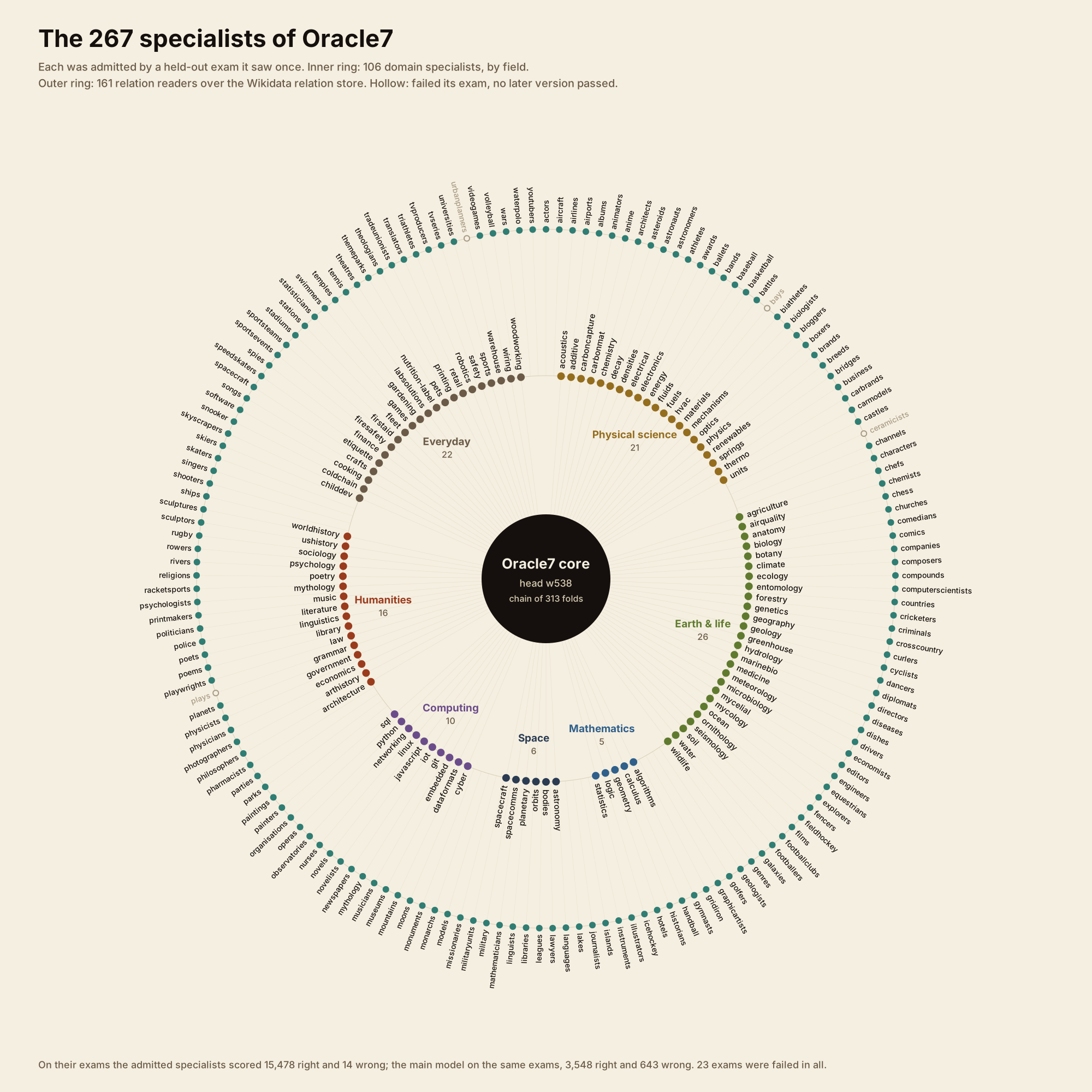
Right and wrong answers of the 267 admitted specialists on held-out exams they saw once. 23 specialists failed their exams and stayed out.
Capability checks passed after the math, relation, dialogue and code organs were connected to the served model (w480, w482). No check lost; no new wrong assertion.
Confidently asserted wrong programs on 500 held-out coding tasks, once the code organ grades its own evidence (w486). Every program is still shown; thin ones are marked tentative and ask for one more example.
An unanswered turn. 71% of all turn time was one 122 MB file rewritten on every refusal; the gate rejected the speed fix alone because it has no latency column.
Pointer bound to an acknowledgement word: 15 of 20 test conversations before w472, 0 of 20 after. No other metric moved.
Deliberately broken rule sets submitted to oracle7-deepspace's gate. All four rejected; nine real improvements admitted in 45 seconds.
oracle7-deepspace on fresh spacecraft faults, against 29.4% for a simplified limit-to-safe-mode baseline. Zero harmful actions.
Six models, one substrate, one gate each
| Model | What it does | Measured on held-out data | Status |
|---|---|---|---|
| oracle7 | Conversation through 267 verified specialists, 20.5M cited sentences and typed relations | Sealed test 17: 111 right / 5 wrong (95.3%) · math 1,113 right / 191 wrong on held-out textbook exercises | head w538 |
| -deepspace | Spacecraft fault management, self-maintaining | 98.9% vs 29.4% baseline; 0 harmful | paper + live |
| -vision | Recognition that cites the examples it matched | MNIST 98.58% · Fashion 90.46% · CIFAR-10 62.99% | internal 2.0 |
| -trafficcop | Routes each request to what should answer it | 30/32 held-out routes | panel pending |
| -chameleon | Builds and re-skins websites | 1/4 first-pass; 0 false completions | internal 2.0 |
| -artist | Composes images from cited parts | GenEval-style 50.9%, with no generative model | internal 2.0 |
Where the core model falls short today
Measured 13 October 2026 on development windows of five open benchmarks, 250 questions each, never used for reported results. Most declines happen before retrieval: the front parser does not recognise about half of ordinary trivia phrasings ("X tried to assassinate which British monarch?"), and the relation specialists cannot answer those either. Multiple-choice questions are not attempted. Next: a verified reader for that class, a multiple-choice solver, and fewer wrong yes/no readings.