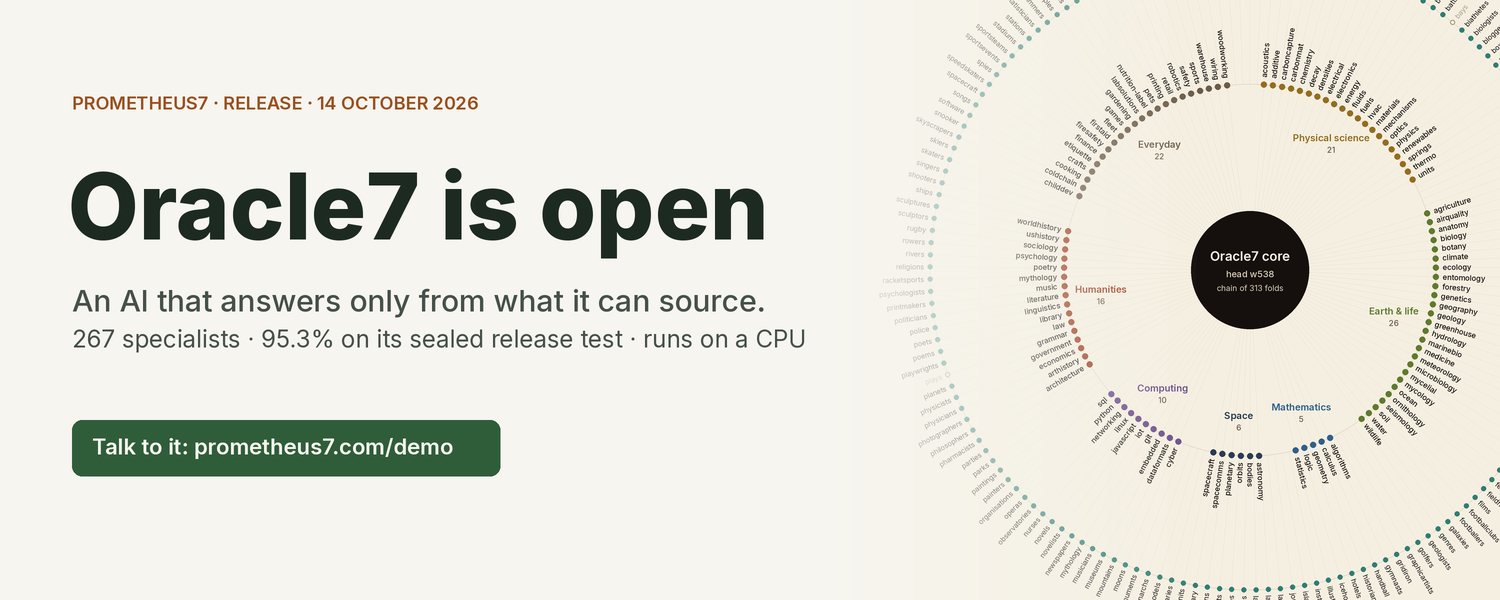
Oracle7 is open
An AI that answers only from what it can source is now on Hugging Face, in full. This is what it is, how we tested it, and where it goes next.
Today we released Oracle7 on Hugging Face. The release contains the main model in two variants, all 267 of its specialists, five systems built the same way, and Oracle7-infrastructure, an agent that watches servers. It runs on an ordinary CPU. No neural network runs when it answers a question.
You can talk to it now at prometheus7.com/demo.
What it is
Most AI systems today are generators. Asked a question, they produce the most plausible continuation of the text. They are fluent and broadly useful, and plausible and true coincide often enough to trust and not often enough to rely on.
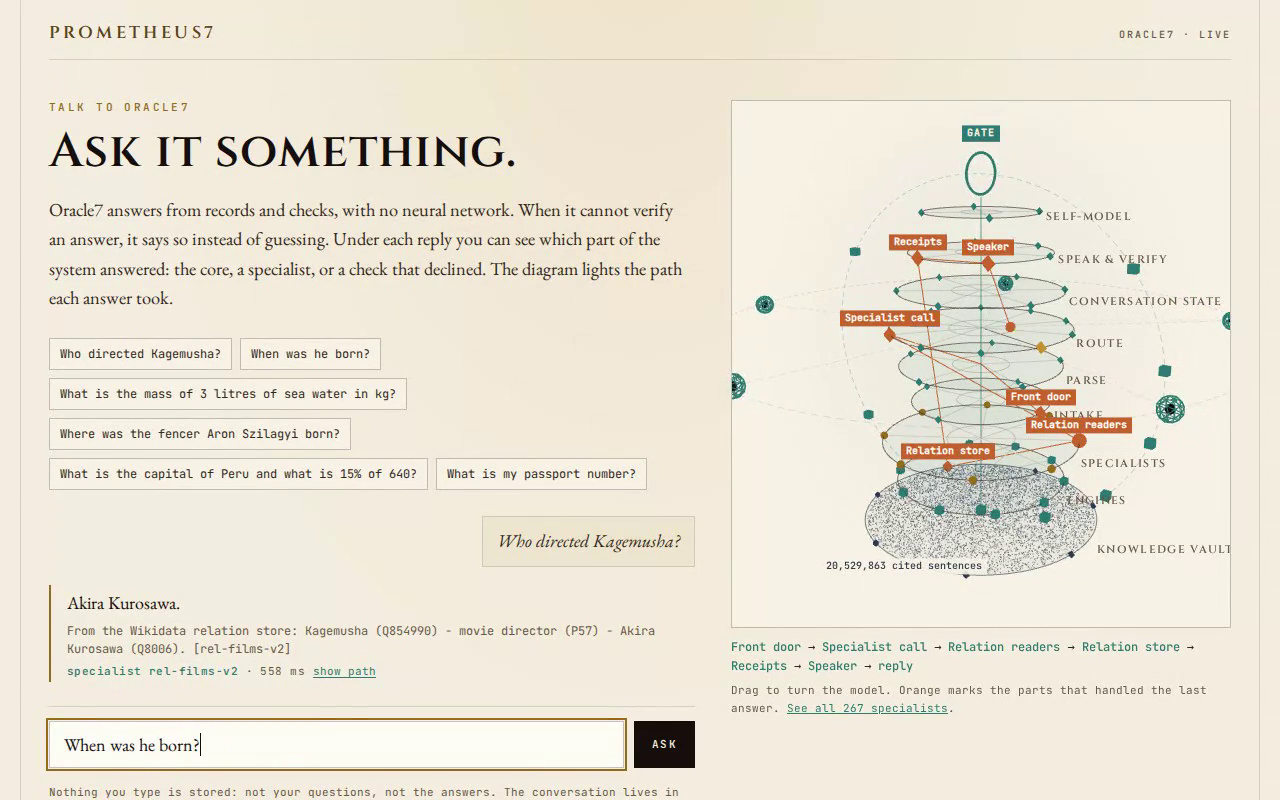
Oracle7 works differently. It reads a question into a typed request, routes it to the part of the system responsible for that kind of question, and answers only from stored records or exact calculation. Every relation answer carries a receipt: the record it read, with identifiers at both ends. When it can't verify an answer, it declines and says why.
Who directed Kagemusha? Akira Kurosawa. From the Wikidata relation store: Kagemusha (Q854990), movie director (P57), Akira Kurosawa (Q8006).
Ask "When was he born?" and it reads "he" as Kurosawa, hands the question to its directors specialist, and answers 23 March 1910 with that record. Ask "Who painted The Night Watch in 1990?" and it replies that its records date the painting to 1642, not 1990.
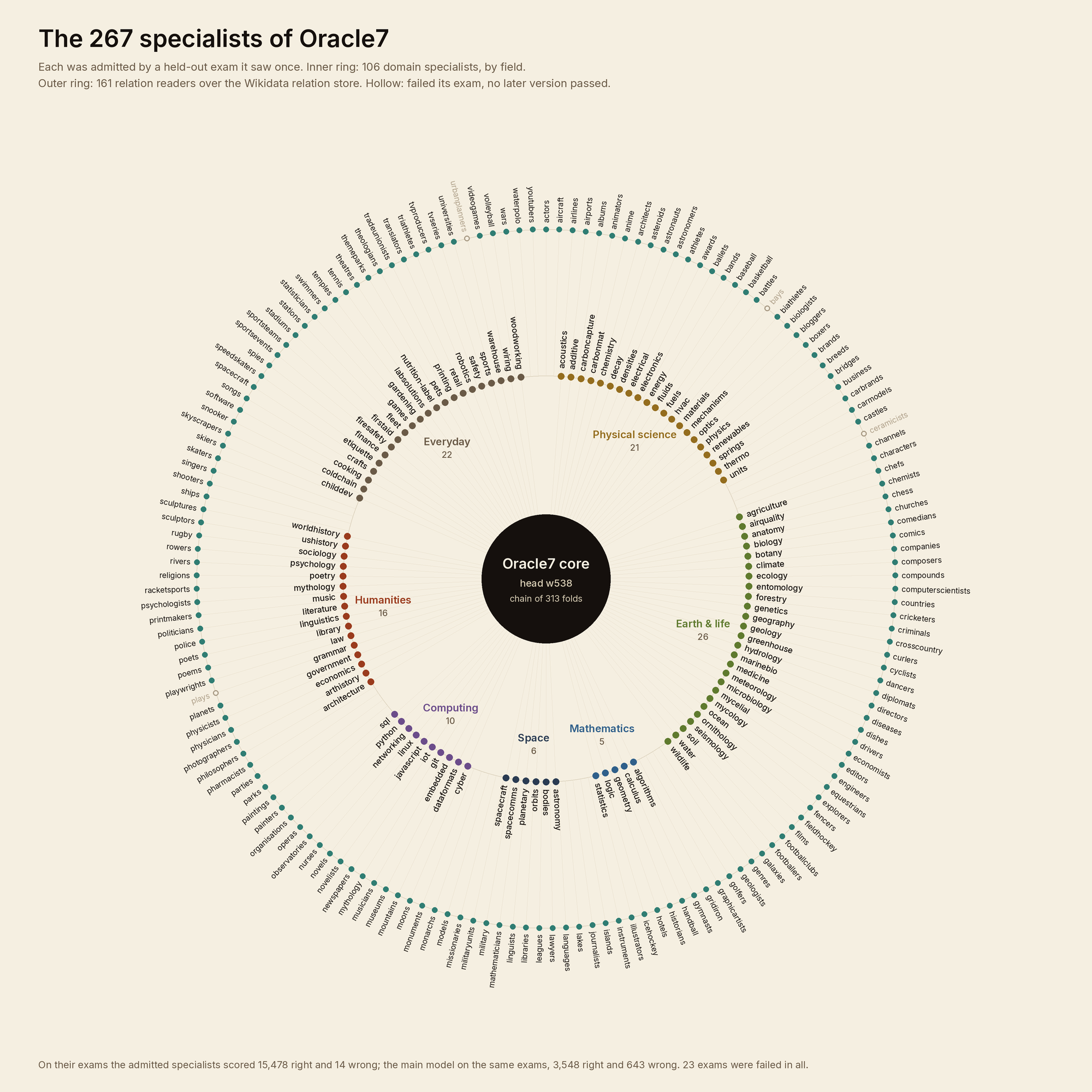
The 267 specialists are small programs, each for one kind of question. 161 read one kind of relation, such as who directed a film or which planet a moon orbits; 106 compute or look things up within a field, from physics to first aid. Each was admitted by a held-out exam it saw once. On those exams the admitted specialists gave 15,478 right answers and 14 wrong ones. The main model, on the same exams, gave 3,548 right and 643 wrong. 23 specialists failed their exams; those results are published too.
How we tested it
Oracle7 is never retrained. It changes through small modules called folds, and every fold must pass a gate of 4,114 held-out checks: if it loses one right answer or adds one wrong one, it is rejected. 317 folds are in the released chain.
Sealed tests have run since early October. Each is written and hashed before the build it measures, and run exactly once. The first ones were humbling. On sealed test 3, on 2 October, only 68% of the answers it gave were right. Each failure was traced and fixed through the gate, and by test 11 on 3 October it answered 98 of 150 questions without a single wrong answer.
Test 9 was retired unscored because the harness that ran it was found to be contaminated; that is recorded too. For the release we wrote harder tests.
The final tests each have 150 questions, written and hashed before the build and run exactly once. The bars are at least 90% precision on what it answers, no more than two false answers, and no format defects. We ran six of them on 13 October. Tests 12, 13 and 14 failed: a dropped minus sign, private questions answered from an encyclopedia, a thousands separator misread, a word read in the wrong sense. Each failure was traced to a cause and fixed with a general rule that passed the gate. Tests 15, 16 and 17 passed. On release day we added a reader for questions one fact away from something the question names, measured on 6,000 questions it had never seen: 81 of its 82 answers were right. Test 18, written before that fold was built, failed: 4 answers to questions that should have been declined, one of them the new reader's ("Which planet orbits the Moon?" answered "Earth"). We traced them, added guards that withhold those answers and none of the reader's right ones, wrote test 19 fresh, and ran it once: 117 right, 3 wrong, 97.8% precision.
That last line needs saying plainly. On public trivia benchmarks Oracle7 declines most questions, because it won't answer what it can't source. Of the 131 it answered across nine benchmark windows, 100 were right. If you want broad coverage, use a language model. If you need to know where an answer came from, and you'd rather have no answer than a wrong one, this is built for you. All the tests, every run and the failures are in the release.
The Workbench
The download comes with a workbench: python oracle7.py --workbench opens a page on your own machine with the diagram of the model, which lights the path each answer takes. You can point it at your computer, a server you reach over SSH, your own tables and notes, or an MCP server, and each becomes a reader that names where every value came from. You can write your own specialist in the page and examine it the way ours were examined: it joins your model only if it passes a held-out exam it sees once, and it can only answer where the core declined. Conversations are kept on your machine, and any conversation can become a temporary specialist that remembers it. Nothing leaves your computer unless you connect a service yourself.
Every part of the release is hashed: each of the 307 specialist folders, the 313-fold chain, the workbench and the launcher. A Merkle root over those hashes is written to Solana in a single transaction. The workbench recomputes the hashes from your download and checks the root against that transaction, so you can confirm you hold exactly what was released.
What it found on our own servers
On 12 October we installed Oracle7-infrastructure on our four servers and told it nothing. Within an hour it had found 278 services, 165 scheduled jobs, 102 websites, 56 certificates and 182 open ports. Six services were stuck in crash loops; one had restarted 144,690 times without any of us noticing. Two websites were down. Certificate renewal was failing on two machines, and instead of raising an alarm it read the certificates themselves and reported the soonest expiry: 51.5 days away. It changes nothing until a person approves, and then it measures whether the change worked. It uses 15 to 55 megabytes of memory.
Where it goes next
Oracle7 runs on almost nothing, so it can live where a language model can't: on the processor already inside a machine, or on a sensor node powered by a small solar cell. That is the next stage. Prometheus7 will sell the sensors that let it read the physical world, in three places:
- Infrastructure: servers, sites and jobs, which Oracle7-infrastructure already watches.
- Industry and buildings: a machine node that reads vibration, motor current and temperature and warns of failures with its evidence. It can only read; it has no way to change the machine.
- The living world: a tree that can tell you how much water it drew up yesterday, how early its leaves came out, and how much cooler the pavement under it runs. Then a stream, then soil.
Two design rules matter most. First, a signature proves where a reading came from, not that it's true: a probe in a cup of warm water produces a perfectly signed reading. So every reading must agree with independent physical channels. Sap flow follows how dry the air is, the trunk shrinks by day as sap flows, and rain under the canopy stays below rain in the open. Faking one channel is easy; faking five that stay physically consistent for weeks is close to impossible. Second, every sentence says how it is known (measured, recorded, inferred, forecast, or not shared) and how precisely, as in "about 110 litres yesterday, give or take 25".
Why it's open
The sensors are sold; the intelligence is held in common. Oracle7 runs locally, keeps data where it is collected, and shares only facts a place's custodian chooses to share. There is no centre to switch off, including us. The exam that admits a sensor is open, so anyone can run it. We think an intelligence that will one day sit in streets, fields and machines should be something people can inspect, own and trust, not rent.
We're raising
We are raising to put the first sensors in the field: a tree, a stream and a machine, each with its sensors examined, its readings signed, and its answers backed by receipts. The plan, the presentation and the technical appendix are at prometheus7.com/Investors.
Try it at prometheus7.com/demo. The model, the specialists, the tests and every result are on Hugging Face. Sealed-test figures are from the release's own result files; the deep-space and sensor work described on the investor page is in simulation or design, and is marked as such there.